Em Português... CLICAR AQUI

Sunday, June 8, 2014

About refreting: Why, when and what


In this post we will look at refretting an instrument when to do it and why, what you can expect from your new frets and some of the different options and how they affect playability and sound.


Frets wear out after some time. How long they last depends on what they are made of, your playing style, how hard you fret the notes and of course how many hours you spend playing.


Worn frets cause fret buzz and they can make the notes and chords sound unclear and even out of tune. 


If your frets are high enough and not too worn you can level them, this consists of filing down every fret removing the dents and removing material from the least worn ones, that way all of them go back to being the same height. This can be a solution if the fret wear is very little, and if the frets are tall to begin with. With heavily worn frets or shorter ones I highly recommend a refret.

If your frets show little wear that doesn't affect the sound or your way of playing I usually recommend not changing them or doing a fret leveling job, just keep playing them until they wear out more.

Refrets are not a small easy job, it's always invasive and some woods handle it much better than others. Frets were not made to come off, taking them out if not done carefully will chip the wood it can also make the slots (were frets sit) enlarge thus making it much harder to put new frets in and make them stay in place.
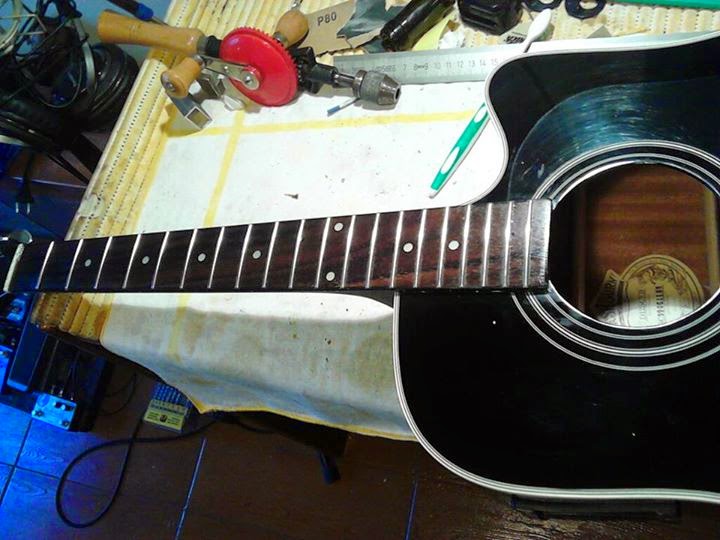

Whenever a client comes in for a first time refret we talk for a while to decide what frets to put in, the choice can be a bit overwhelming at first. There are different materials, shapes, sizes. New frets can make or break a guitar so it's important that you are sure of what you want, so if someone isn't sure I always have guitars with different frets, playing always gives you a much better idea than size charts.


Jim Dunlop makes their accu frets out of german silver, it's a nickle copper alloy, that I tend to like a lot, they are durable, they have a crisp sharp attack.
Jescar uses several types of material from german silver to an alloy they call EVO Gold to stainless steel.
Jescars EVO are nickel free they were made with people that are allergic to nickel in mind, they are very durable, but unfortunately they don't have as many choices of sizes compared to Jim Dunlop.

A material that was been gaining importance especially in the world of custom builders is Stainless Steel or SS. Stainless Steel is very hard and dense. It's heavy, long lasting, and when working with it you need tough tools, some files will have a hard time scratching it let alone filling them down.
They have a very clear, loud sharp attack. Even tough they are hard to work with I really like them you can get them to be mirror smooth with the right tools.

These are the hardest and longer lasting alloys I have worked with. Of course they aren't the only options. I've seen frets made with zync and even lead alloys, these usually come in cheaper guitar and are very very soft, they look and sound dull.

First electric bass

Since we are doing firsts today, here's the first electric bass, or the first one that comes close to a modern electric bass, solid wood body, smaller size (42inches in total) and played horinzontaly instead of upright.

Invented by Paul Tutmarc the Audiovox Model 736 from 1937 (the first prototype was created in 1933):


First electric guitar

The first electric guitar. 
Released in 1932 the Rickenbacker Frying pan was an attempt at fixing the age old problem of guitar players needing more volume.


And thanks to the wonders of the internet you can hear it in action here:
http://www.youtube.com/watch?v=ndhGJHNqbMc

Thursday, December 6, 2012

Super Strats or a look at guitar evolution

One of the things I love about my job is how many guitar I get to see, study and fix. And talking to clients, you get a better understanding of how people's taste and choices when it comes to the guitars they like is always evolving.

Yamaha Blues Saraceno before the Setup

The 1980s Super guitar was about being seen from 5 miles away (less than that and you end up blind by a flash of red, yellow, pink, green or all the above). Necks were slimed down, fretboards became flatter, and single coils were replaced with passive higher output humbuckers or active systems. All in the name of confort and tone.


59 Les Paul - notice the wear on the edge of the fretboard.
However times change and so does taste, and guitarists started looking at the beginning of the electric guitar, the iconic models. What some years ago was old, boring and obsolete, was now the holly grail, the 1959 Les Paul, the early strats and teles.
There was something about the way they felt and sounded that people loved and looked for, helped by a very retro feel that started to overtake the music industry.

In this this day and age both the vintage and the 1980s super guitar is sought after and loved.
And a lot of builders and brands focus on building something new, taking the best parts of both worlds.

I find this truly fascinating, when you take the things you like on several guitars and build another one joining them all in one instrument.

James Tyler and John Suhr are two examples of builders that updated the strat and tele design with some modern conforts and new finishes.


The first time I played a James Tyler guitar I noticed there was something about the neck that made it incredibly comfortable and it wasn't just the shape and size, something about the way your fretting hand felt was incredibly pleasing and just made you want to play.

James Tyler Mongoose - detail of the heavily rounded fretboard


Took me a while to figure out that the fretboard edges were rolled, instead of being squared off and sharp they are rounded, allowing your fingers to wrap around the fretboard perfectly. Just like you would find on an old instrument that has been played a lot. It's simple and it makes a huge difference on your playing.


Surh Standard is thinner and more contoured than your average Strat.

John Suhr alters the shape of a strat in order to make more comfortable and uses custom wirings to shape the sound of the pickups and how their potentiometers work.


We started to look at tone in a different way, nowadays you have a huge selection of pickups not just for higher and lower outputs. You can have a humbucker that sounds like a vintage single coil, just without the hum.


Noticing the things you like in a guitar and how they influence the sound can help a lot when modifying a guitar or ordering a custom build one, but we will leave that for another post.


Photo sources:
Musicradar.com
Rocketmusic.net
Burstserial.com

Samick Acoustic Electric

Since many guitar players start playing on an acoustic I saw as fitting that my first posted work would be about one.

This is an acoustic electric by Samick that came to the shop, with quite a few years under her "belt" (ladies and gentleman presenting this blog's first pun).

As far as damage goes the truss rod needed some adjusting, some tuners were too loose and didn't held tuning others too tight and you almost couldn't turn them.
Frets were dirty and showing signs of wear, and the fretboard was full of grime and completely dried up and the action was too high.


Fortunately the truss rod was fine despite being a bit stiff at first, but after adjusting it worked perfectly.
The tuners needed some repair work but by the end of the setup every single one of them turned smoothly and evenly. Neck was straight and tuners were fixed. Moving on to the frets and the fretboard.

To give you a better idea of how high the action was before and after the setup I used euros coins (1 euro to be precise).
Lowering the action makes the guitar become more comfortable to play, it's easier on your fretting hand and that can help make the notes sound cleaner, and bending strings requires less effort because you are reducing the tension on the strings, which makes it easier on not only you but also the guitar neck and the top (in the case of acoustic instruments).


There are no exact measures for the action, I adjust them according to how the client wants it. It all boils down to a question of taste, technique, comfort and the sound you are looking for.

 
Frets were cleaned and micro polished. I like to leave the frets as smooth as possible, so you don't feel any friction from the fret when you bend or slide.
The fretboard was cleaned and conditioned, and i was surprised to see a quite beautiful grain and color underneath all the grime.


The biggest surprise about this guitar to me was the electric part. It's a passive system by Shadow with a piezo per string, a volume and tone pot. The pickup worked really well in this guitar, the amplified sound is natural and full, none of the thin, harsh highs you get with some piezo pickups. 

The tone pot works well too, never gets muddy and if used carefully can't be quite useful to get rid of excessive highs. 
In this picture you can see the pickup and the wear and tear of the saddles (before I got to work on them).